
The Economic Benefits of Annual Flow Meter Calibration
Executive Summary
Flow meters directly affect product quality, process efficiency, regulatory compliance and billing accuracy in energy, chemicals, aerospace, pharmaceuticals, water management and food processing. Every flow meter drifts over time. Annual calibration restores accuracy to factory or industry standards at a cost far below the losses that drift creates.
Annual calibration is not just a maintenance task. It is a financial strategy that protects revenue, reduces waste, extends equipment life and keeps operations audit-ready.
Why Flow Meters Drift
Bearings, turbine blades, sensors and electronics degrade with use.
Temperature swings, vibration, corrosion and contaminants alter performance.
New fluids, viscosities or flow ranges, and upstream/downstream piping changes, shift the meter’s response.
Deposits on rotors and internals change the flow profile and the meter’s K-factor.
Drift is gradual and usually invisible. A meter can operate normally while reading high or low, so the only reliable way to know is to test it against a traceable standard.
The Economic Case
A 1% measurement error in a process moving $1 million in product a year equals $10,000 in unaccounted loss, every year it goes uncorrected.
The loss scales with throughput:
| Annual product value | 0.5% error | 1% error | 2% error |
|---|---|---|---|
| $1 million | $5,000 | $10,000 | $20,000 |
| $5 million | $25,000 | $50,000 | $100,000 |
| $10 million | $50,000 | $100,000 | $200,000 |
Illustrative annual loss from uncorrected measurement error.
Protect revenue
- Less product loss. Prevents under- or over-measurement in billing, batching and chemical dosing.
- Billing confidence. Verified accuracy virtually eliminates custody transfer disputes and customer chargebacks.
Lower operating costs
- Process efficiency. Accurate data supports optimized setpoints: lower energy use, less over-pumping and recirculation, and better chemical usage.
- Lower repair costs. Calibration finds bearing fatigue, rotor imbalance, electronics degradation and buildup before they cause failures.
- Longer meter life. A properly maintained meter can deliver accurate performance for decades.
Reduce risk
- Less downtime. Scheduled calibration costs far less than an unplanned outage.
- Audit protection. Current calibration records help avoid audit findings, fines, shutdowns and rework.
- Safety. Accurate flow control prevents the hazards that come with improper dosing, overfilling and over-pressurization.
What Standards and Regulators Expect
Most quality and regulatory frameworks require measuring equipment to be calibrated at defined intervals against standards traceable to national or international standards, with records to prove it.
| Framework | Calibration expectation |
|---|---|
| ISO 9001:2015 (cl. 7.1.5.2) | Calibrate at specified intervals with traceable standards. When equipment is found out of tolerance, assess whether earlier results are still valid and take action. |
| AS9100D (aerospace and defense) | Same traceability requirement, plus a recall system for equipment due for calibration. |
| FDA 21 CFR 211.68 / 211.160 (pharma) | Instruments must be calibrated on a written schedule, with records kept. |
| API MPMS Ch. 5.3 and Ch. 4 | Turbine meter measurement and proving practices for custody transfer of liquid hydrocarbons. |
| NIST Handbook 44 / OIML R 117 | Accuracy and testing requirements for commercial (legal-for-trade) liquid measuring systems, including cryogenic liquids, in the U.S. and internationally. |
| EPA and state permits | Flow data used for environmental reporting must come from calibrated, documented instruments. |
Calibration Program Best Practices
- 1
Start with annual calibration. Annual is the industry baseline. Shorten the interval for critical, custody transfer or severe-service meters. Extend it only when several cycles of as-found data show the meter stays stable.
- 2
Record as-found and as-left data. As-found results show how far the meter drifted. They also tell you whether product measured since the last calibration needs an impact review.
- 3
Calibrate to service conditions. Turbine meters respond to fluid viscosity and flow rate, so calibrate across the operating flow range on a fluid that represents actual service.
- 4
Maintain a calibration inventory. Track every meter’s serial number, location, criticality and due date so nothing goes overdue.
- 5
Recalibrate after events. Recalibrate after repairs, process changes, upsets or any reading you don’t trust, not only on the calendar.
Choosing a Calibration Provider
ISO/IEC 17025 accreditation with a scope that covers your meter type and flow range. Accreditation through an ILAC MRA signatory is recognized internationally.
Traceability to national standards (such as NIST), with stated measurement uncertainty on every certificate. A common rule of thumb is a test uncertainty ratio of at least 4:1.
Complete reports with as-found and as-left results, the K-factor or calibration curve, and the standards used.
Diagnostic capability and OEM parts, so worn components are found and corrected, not just measured.
Why Hoffer Flow Controls
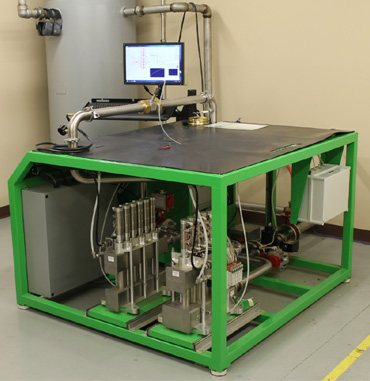
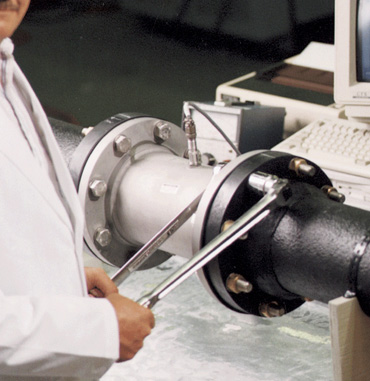
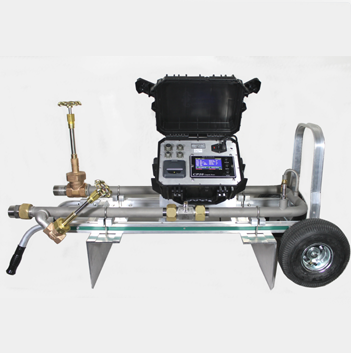
Hoffer Flow Controls provides full in-house calibration accredited to ISO/IEC 17025, backed by more than 50 years of experience designing, manufacturing and repairing turbine flow meters.
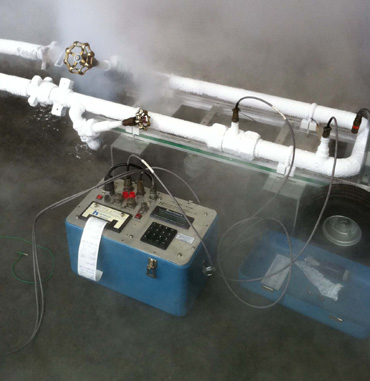
- Accredited calibration for turbine flow meters and related instrumentation, including cryogenic service
- Detailed reports with before-and-after results for full traceability
- Rapid turnaround to minimize downtime
- Expert diagnostics that detect early signs of wear
- OEM parts and service from the original manufacturer
Conclusion
The cost of annual calibration is small compared with the losses from inaccurate measurement, equipment failure or non-compliance. Operations that calibrate annually see higher accuracy, lower operating costs, longer equipment life and stronger compliance. Where flow measurement matters, annual calibration is essential, not optional.
Contact Hoffer Flow Controls
For calibration scheduling, technical support or more information, contact the Sales and Service Department at +1 (800) 628-4584 or visit www.hofferflow.com.